A dental crown vs bridge decision starts with one clinical question. Is the natural tooth still present, or is the space empty? A crown covers a compromised tooth that remains structurally restorable. A bridge replaces one or more missing teeth by spanning the empty space. The American Dental Association describes a crown as a restoration that recovers a tooth's shape and strength. It describes a bridge as a fixed partial denture that replaces missing teeth. Neither restoration is better for every mouth. Each one solves a different structural problem.
Schedule a crown or bridge consultation in Glastonbury
At Advanced Cosmetic and Implant Dentistry, board-certified prosthodontists Dr. Avinash S. Bidra and Dr. Xiao Chun Li plan these restorations in one Glastonbury office rather than splitting surgery and the final tooth between practices. The appropriate choice depends on the remaining tooth structure, the teeth beside the gap, your bite, and whether an implant would preserve healthy neighbors.
Patients often ask which option is stronger, or which one looks more natural. That framing misses the first clinical distinction. A crown and a bridge are not two versions of the same repair. One rebuilds a tooth that is still present. The other replaces a tooth that is already missing.
Use the tooth itself as the test:
A dental crown can also be attached to a dental implant after a tooth is removed. In that design the crown is the visible tooth, and the implant functions as the root. That arrangement differs from a bridge, which borrows support from neighboring teeth.
Our porcelain dental bridges are planned when a gap needs a fixed replacement and the supporting teeth can carry it. If those neighbors should not be reshaped, an implant-supported option belongs on the table before anyone commits.
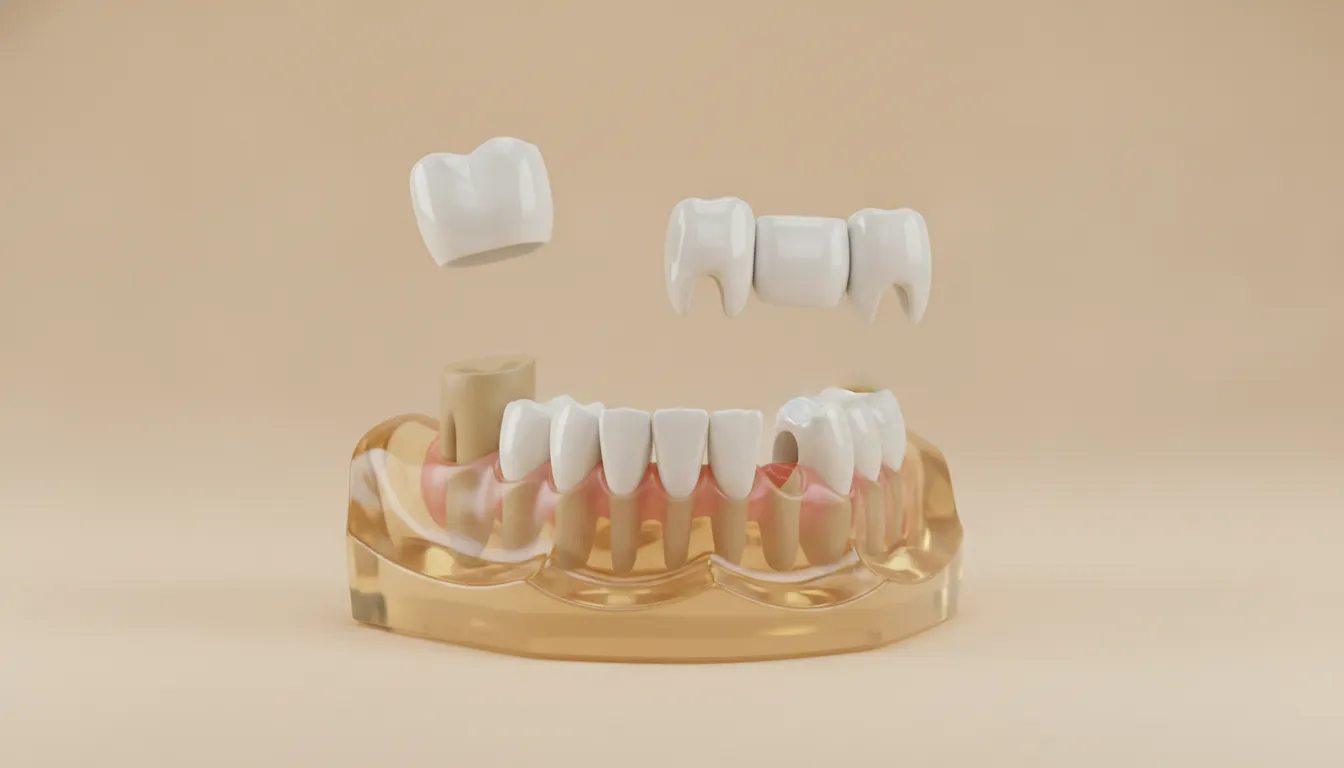
A crown is a custom cap over a prepared tooth. It covers the visible portion, and sometimes a small margin under the gum, so the tooth can chew and look like itself again. The ADA mouthhealthy guide to crowns notes several uses for a crown. It can strengthen a tooth with a large filling or protect a weak tooth. It can restore a broken tooth, improve shape, attach a bridge, or cover an implant.
Common reasons a prosthodontist recommends a crown include:
The tooth must be prepared so the crown can seat completely and the bite can close evenly. Preparation removes a measured amount of enamel. The tradeoff is a stronger outer surface in exchange for reduced natural tooth structure underneath. If too little tooth structure remains, the plan may require a build-up, root canal treatment, or a different restoration.
Material, visit steps, and how long a crown can last are covered in our guide to dental crown types, process, and care. This article stays with the choice between a crown and a bridge, not the material catalog.
A traditional bridge replaces a missing tooth by joining a false tooth, called a pontic, to crowns on the teeth beside the gap. Those supporting teeth are abutments. The ADA guide to bridges describes a bridge as artificial teeth that close the space where teeth used to be, attached to surrounding teeth for support. A fixed bridge stays in the mouth. Only a dentist removes it.
For one missing tooth, the usual design is a three-unit bridge. Two abutment crowns and one pontic are fabricated as a single piece. Replacing two missing teeth can mean a longer bridge, which asks more of the teeth that hold it.
The practice's bridge page is clear about candidacy. A traditional porcelain bridge needs healthy teeth on both sides of the space. It is a poor match when those teeth need major corrective work first, or when there is not a sound tooth at each end of the gap.
Preparing the abutments is the tradeoff patients should understand before agreeing. Those teeth are reduced so the bridge crowns can fit over them, even when they were previously healthy. That is the main cost of a traditional bridge. You restore the gap, and you change teeth that did not have a problem of their own.
If one of those teeth already needs a crown, using it as an abutment can make more sense. The tooth was going to be covered anyway. If both neighbors are sound, an implant that leaves them untouched is often the more conservative long-term plan.
See how a dental implant can replace one missing tooth
This table is a decision aid, not a diagnosis. Your bite, X-rays, and the condition of the neighboring teeth can change the recommendation.
| Question | Dental crown | Traditional dental bridge |
|---|---|---|
| What problem does it solve? | A damaged tooth that can still be kept. | One or more missing teeth in a row. |
| Is the original tooth still there? | Yes. The crown covers it. | No. A pontic fills the empty space. |
| What holds it in place? | The prepared tooth, or an implant. | Crowns on the teeth beside the gap. |
| Do neighboring teeth get reshaped? | No, unless they need their own care. | Yes. Abutment teeth are prepared for crowns. |
| Can it replace a tooth that is already gone? | Only if it is placed on an implant. | Yes. That is its main job. |
| Daily cleaning focus. | Brush and floss the margin like a natural tooth. | Clean under the pontic as well as around the crowns. |
A crown is not a shortcut bridge, and a bridge is not a crown for a gap. If a dentist uses the words together, ask which tooth is being saved and which space is being filled.
Support is the difference that determines comfort years later. A crown on a natural tooth depends on that tooth's own root. The root still feels pressure, and the bone around it still gets the signal of chewing. The crown fails if the root cracks, decay starts at the edge, or the bite is too heavy for what is left.
A traditional bridge uses neighboring teeth as posts. Those abutments carry the chewing load of the missing tooth as well as their own. They need enough root length, solid bone, and a healthy nerve, or a plan for the nerve if the preparation comes close to it. Gum disease around an abutment is a reason to pause. A loose supporting tooth cannot hold a fixed bridge.
The bite matters just as much as the foundation. A crown that sits high can bruise the ligament around the root. A bridge that is high can overload both abutments. Front teeth need a shape that looks right and clears the lower teeth when you speak and chew. Back teeth need cusps that grind food without rocking the bridge.
This is why a board-certified prosthodontist is a useful person to ask when the case is not simple. Dr. Bidra and Dr. Li are board-certified prosthodontists, the specialty trained in both the surgical and restorative sides of tooth replacement. Dr. Bidra also directs the prosthodontics residency at UConn School of Dental Medicine. Complex bites, worn teeth, and teeth that have already failed once are the cases this office plans every week.
A dental crown vs bridge article is incomplete if it stops at those two. When a tooth is missing, a single implant with its own crown can replace the root and the tooth without cutting the neighbors. The implant is placed in the bone. After healing, a custom crown attaches to it.
An implant is not always available on day one. You need enough bone, or a graft that can create it, and gums that are healthy enough to maintain. Medical history, smoking, and the position of the sinus or the nerve can change the timing. Some patients can have a tooth removed and an implant placed on the same day. Others need the site to heal first. Our note on same-day extraction and implant timing covers when that is realistic.
A bridge can still be the better fit when:
An implant is often the better fit when the teeth beside the gap are healthy and you want to leave them alone. The practice's dental implant care includes single-tooth replacement as well as full-arch treatment. A single missing tooth does not require an All-on-4 bridge. That full-arch option is a different treatment for a whole row of failing teeth.
If many teeth are worn, broken, or missing, the comparison of one crown and one bridge is too small. Full mouth reconstruction looks at the bite as a system. Crowns, bridges, and implants may all appear in one plan, each used where it solves a specific problem.
The steps below describe a typical fixed crown or traditional bridge in this office. Your sequence can be shorter or longer if a root canal, extraction, or implant is part of the plan.
A same-day crown can cover a prepared tooth while a custom porcelain crown is made, so you are not left with a broken tooth during the wait. That temporary is a convenience. It is not a reason to pick a crown when the tooth is actually missing.
Front-tooth cases need extra time on the shape and the gum line. If the goal is a broader cosmetic change, a crown may be one piece of a smile design plan rather than the whole treatment. A veneer is a different restoration. It covers the front of a tooth and does not replace a missing tooth or a tooth that needs full coverage. Read the practice guide to choosing dental veneers if appearance, not a missing tooth, is the real question.
Both restorations depend on the same daily basics. Brush twice a day, clean between the teeth once a day, and keep regular exams. The difference is where debris hides.
Around a crown, the vulnerable spot is the margin where porcelain meets tooth. Decay can start there if plaque sits at the gum line. Floss should slide between the crown and the next tooth and come out clean. If floss shreds or the contact is too tight to enter, tell the office. That is a fit issue, not something you should work around.
Under a bridge, the pontic rests against the gum but does not emerge from it. Food packs in that space. A floss threader, a superfloss strand, or a water flosser needs to pass under the false tooth. Brushing only the cheek side leaves the underside dirty. That is the most common reason a bridge's supporting teeth develop decay or gum inflammation.
Call the office if you notice any of these:
A loose bridge needs prompt attention. If an abutment crown lifts, bacteria can leak under it within days. Do not glue it at home. A short visit can often recement a sound bridge. Waiting can turn a recement into a new bridge, or into decay that costs the supporting tooth.
Insurance coverage is a separate question from which restoration you need. Many plans treat a crown or a bridge as a major service and pay a percentage after a waiting period. The practice is out of network with most plans and can help you submit a claim. Financing through CareCredit, Proceed Finance, and Cherry is available if you would rather divide the fee. What a plan pays should not be the reason to crown a healthy neighbor or to bridge a site that would do better with an implant.
Bring three facts to the consult, even if you only know them in plain language. Which tooth hurts or looks wrong? Is that tooth still in your mouth? Have the teeth beside it ever been crowned, root canaled, or loosened?
Then ask these questions:
A careful answer will name the tooth, the support, and the tradeoff. A vague answer that jumps straight to a fee is a reason to slow down. Prosthodontists train for this judgment. Our comparison of a prosthodontist and a general dentist explains the extra residency behind that planning, especially when implants are involved.
You do not need to choose the restoration from an article. You do need the decision to match the problem. A cracked molar with a solid root is a crown conversation. An empty space between two teeth is a bridge or implant conversation. Mixing those up leads to treatment that looks finished and still fails the job.
Talk with a prosthodontist about your tooth or gap
No. A crown covers one tooth. A traditional bridge uses crowns on the teeth next to a gap and a false tooth in the middle. People mix up the names because a bridge is built from crowns that are joined together.
Not on an empty gum. A crown needs something to sit on. That is either the remaining natural tooth or an implant placed in the bone. If the tooth is gone and there is no implant, the replacement is a bridge, a denture, or an implant plan, not a crown alone.
For a traditional fixed bridge, yes. The abutment teeth are prepared so the bridge crowns can fit over them. If those teeth are healthy, ask whether an implant would replace the missing tooth without changing them. If they already need crowns, a bridge may put that preparation to work.
A single crown is cleaned like a natural tooth, with extra care at the edge. A bridge needs cleaning under the false tooth every day, because the pontic does not seal against the gum. Many people do well with either one once the cleaning method is clear.
Start with whether the tooth is still present and restorable. A prosthodontist confirms that with an exam and an X-ray, then compares a crown, a bridge, and an implant against your bite and the teeth next door. The useful outcome is a plan that says what is being saved and what is being replaced.
A dental crown and a dental bridge both rebuild a smile, and they are not interchangeable. Choose a crown when a damaged tooth can still function. Choose a bridge when a gap needs a fixed tooth and the neighbors can support it. Ask about an implant when cutting those neighbors would cost more than it saves.
Advanced Cosmetic and Implant Dentistry plans this work at 300 Hebron Avenue, Suite 112, Glastonbury, for patients from Greater Hartford and across Connecticut. Bring the tooth, the gap, or the old restoration that is failing. You will get a recommendation tied to what is actually in your mouth.
Patients in Hartford, CT, can experience unmatched quality and value by choosing board-certified doctors Avinash Bidra and Xiao Chun Li.
We are affiliated with the following prestigious organizations: